Sacheerome: What makes you smell so good?
 Micro cap
Fragrances and flavours
13 September 2026 · 35 min read
Micro cap
Fragrances and flavours
13 September 2026 · 35 min read
What the company does
Sacheerome makes the fragrances that go into soaps, detergents, deodorants and incense sticks, and a smaller line of flavours for sweets and drinks, to order for consumer-product companies. Fragrance was ₹143.5 crore of FY26 revenue, 94.2%; revenue was ₹152.4 crore and profit ₹28.4 crore. It has 1 factory, in Okhla in Delhi, 173 permanent staff and a second plant at YEIDA on the Yamuna Expressway that began trial runs in September 2026. It listed on NSE's SME platform in June 2025 at ₹102 a share. The promoter is Manoj Arora, a third-generation perfumer, whose family holds 71.54%.
- A Delhi family firm that makes the scent in soaps and detergents. It mixes fragrances to order for consumer-product makers, and fragrance brought in ₹143.5 crore, 94.2% of FY26 revenue. The founding family listed it in June 2025 and still owns 71.54%.
- Sales and profit have grown fast, and it has no debt. In FY26 sales were ₹152.4 crore, up from ₹70.5 crore in FY23, and profit after tax was ₹28.4 crore. It has no borrowings, and the business brought in ₹26.1 crore of cash in FY26, so the profit is turning into cash.
- The old factory is full, and growth has slowed. Its only factory ran at about 124% of its capacity in FY26, by management's account. Sales in the second half of FY26 were ₹75.8 crore, 1% below the first half's ₹76.6 crore, and H1 FY27 revenue of ₹84.48 crore grew 10.34%, against 42% in FY26.
- The new plant is late, and the growth plan rests on it. The money raised at listing is building a ₹184 crore plant first promised for March 2026; trial production began in September 2026, 6 months late, with a new reason given at each delay. Management's target of ₹200 crore of revenue in FY27 needs that plant, and a ₹60 crore project loan sanctioned by HDFC Bank means the company is unlikely to stay debt-free.
- A few unnamed customers buy about half of what it sells. In FY25 the top 5 customers bought ₹53.0 crore, 49.3% of revenue, and none is on a long-term contract. No customer is named in any company document, and the FY26 investor presentation dropped the figure.
- The auditor left, and the paperwork keeps slipping. The auditor that signed the prospectus numbers resigned with immediate effect 7 weeks after listing, over a fee of ₹5.80 lakh against the ₹10 lakh it had proposed. The filings since carry wrong dates and figures that disagree: the promoter put research spending at "around 2.3%" of sales, while the annual report shows ₹20 lakh, 0.13% of revenue.
Why this company, why now
In FY26 Sacheerome reported ₹152.4 crore of revenue, up 42% and ₹28.4 crore of profit after tax, up 78%. 3 years earlier it sold ₹70.5 crore and made ₹6.0 crore. It has no borrowings and ₹45 crore of cash and bank balances, and it earned 27% on average equity and 36% on capital employed even with idle IPO cash on the balance sheet.
The market reads this as a small, debt-free, fast-growing manufacturer about to quadruple its capacity. The filings show a company whose old plant is past its rated capacity, whose first half of FY27 grew 10.34% against 42% the year before, and whose second plant has reached trial production 6 months after the date in the prospectus. IPO buyers paid ₹102 a share; the At a glance card above has today's price. The open questions are whether the next leg of growth arrives on time, whether the price already assumes it has, and how much weight to put on a company whose paperwork keeps showing small cracks.
History
Manoj Arora is a third-generation fragrance entrepreneur with 40 years in the industry, and still the chief perfumer. The company began in June 1992, took its present name in 2012, added flavours in 2014, and was allotted the land for its second factory in 2020. His son Dhruv, a chemistry graduate from Manchester with 14 years in the trade, runs business development.
- 1992 to 2012. Sacheerome Private Limited, a fragrance house in Okhla, built on the family's earlier businesses. The factory sits on land owned by a family firm, Vaishali F&F LLP.
- 2014. Flavours added, for confectionery, beverages and bakery.
- 2020. The YEIDA plot allotted. The old plant's capacity was 7.6 lakh kg a year.
- FY23 to FY25. Revenue from ₹70.5 crore to ₹107.5 crore, profit from ₹6.0 crore to ₹16.0 crore, on one plant.
- March 2024. A 3-for-1 bonus; the promoters' average cost fell to ₹0.47 a share.
- June 2025. The IPO: 60.4 lakh new shares at ₹102, ₹61.6 crore, subscribed 313 times, listed at ₹153 on 16 June.
- August 2025. The auditor that signed the prospectus resigned; J. C. Bhalla & Co. appointed 6 days later.
- FY26. Revenue up 42% to ₹152.4 crore; the plant timeline revised in February, May and August 2026.
- September 2026. Trial production at YEIDA; capacity 27.6 lakh kg on paper.
10 years ago Sacheerome was a private family fragrance house with a single plant. Today it is a listed one with 173 permanent staff, a second plant and a second-generation perfumer being groomed to take over; the business itself, formulas made to order for a few large buyers, is the same.
Value chain
How a fragrance goes from the aroma chemical to the soap, and comes back as a reorder
9 steps, read top to bottom, from the ingredient supplier to the brand's reorder. The shaded names are Sacheerome's own steps; the rest belong to its suppliers, its customers and the licences.

Sacheerome prospectus, annual report FY26, results, call transcripts and business updates · FY25 and FY26
The chain starts with the ingredients: hundreds of aromatic chemicals, natural essential oils, oleoresins and resinoids, bought from Indian importers and makers. 54.7% of FY25 purchases came from Maharashtra and 16.8% from Uttar Pradesh; only ₹13 lakh was imported directly. Materials took ₹60 of every ₹100 of FY26 sales.
The customer starts the work. A consumer-product company writes a brief, who the product is for and what it should smell like, and the perfumers create a formula. The product becomes the customer's property; Sacheerome is "just the custodian", promoter Manoj Arora said on the November 2025 call. The brand tests it in the soap or the drink and approves it. Then the Okhla plant weighs and blends the compound on an automated dispensing line imported from Europe, quality control tests the batch, and it ships by third-party transport to the customer's plant. Once a product smells a certain way, the brand has little reason to risk changing it: "in the last many decades of my business experience, touchwood, we have not lost any business," Arora said.
Who holds the power: the customer, at the order. The top 5 customers bought 49.3% of FY25 sales, none on a long-term contract, and the brief is theirs. Sacheerome's power is in the formula and the switching cost: a brand that changes supplier has to change a smell its buyers know. Could the customer do this in-house? The large ones could hire perfumers; they do not, because a fragrance house carries hundreds of formulas and ingredients for many brands and a soap maker needs only a few. Why this matters: the margin lives in the formula, which costs little to make and much to replace, and the risk lives in 5 unnamed customers.
Products and segments
The accounts report 1 segment, fragrances and flavours. The split is in the directors' report.
Fragrance, mostly. ₹143.5 crore of FY26 revenue, 94.2%: compounds for soaps, detergents, deodorants, hair and skin care, air care, candles and incense. Flavours were ₹8.7 crore, 5.7%, and scrap sales ₹21 lakh. Flavours have been the weaker line: 8.6% of revenue in FY23, down 20% to ₹5.2 crore in FY25, then back to ₹8.7 crore in FY26. Management says both lines earn similar margins, and 1 of the 2 towers at the new plant is for flavours alone.
Which product earns the margin: fragrance, by weight of revenue; the company does not split profit by line. Which one management is pushing: both, through the new plant, with flavours given their own tower, and "premium" fragrances named in the growth strategy. Why this matters: the growth plan rests on selling more of the same fragrances to the same kind of buyers, which is what the company is good at, from a plant 3.6 times bigger than the one that got it here.
How the company makes money
Every product is a formula made to order and sold by the kilo. The fee is the price per kilo of compound, and there is no royalty, subscription or service fee. Revenue is volume times price times mix.
- Volume. Production was 7,40,560 kg in FY25 against 7,60,000 kg of capacity, 97%; management says the plant ran at about 124% in FY26, which puts FY26 output near 9.4 lakh kg.
- Price. Revenue per kilo rose from about ₹1,230 in FY23 to about ₹1,450 in FY25, on the prospectus's production figures. Arora says prices were not raised; customers asked for better products.
- Mix. Fragrance against flavour, and premium against commodity. Exports were 6.2% of FY26 revenue.
Who pays: the brand, on a credit period that works out at 47 days. Core fee against add-ons: there are none; the compound is the whole sale. Of the ₹44.9 crore of revenue added in FY26, ₹31.2 crore came from existing customers and ₹13.6 crore from new ones. Why this matters: most of the growth is big customers buying more, the good kind, and the kind that stops if 1 of the 5 changes supplier.
Customers
The customers are consumer-product makers, FMCG companies and the makers of incense and detergent, in India and a little abroad. None is named in any company document.
Concentration. In FY25 the top 5 customers bought ₹53.0 crore, 49.3% of revenue, and the top 10 ₹62.5 crore, 58.2%, against 45.9% for the top 5 two years earlier. None is on a long-term contract; orders come as quarterly, half-yearly or annual schedules. The H1 FY26 investor presentation had a slide with those concentration figures; the FY26 presentation dropped it, and the capacity utilisation slide, while keeping the line that reliance on top customers "is balanced with a well-diversified portfolio, reducing concentration risk". The FY26 annual report gives no top-customer figure.
Why they buy here, and stay. The formula is made for them and becomes theirs; changing supplier means changing a smell their own customers know. Tenure: the company says it has "not lost any business" in decades. Where they are: Uttar Pradesh and Maharashtra took 59% of Indian sales in FY25, and Maharashtra's purchases nearly doubled from ₹13.4 crore the year before. Abroad, UAE, Bangladesh and Nigeria were the largest export markets in FY25.
Bad debts and complaints. Receivables were ₹19.8 crore, ₹19.4 crore of them less than 6 months old, with no provision for doubtful debts; ₹13,000 was written off in FY26 against ₹35.4 lakh in FY25. There is no complaints disclosure; the company is too small to file a BRSR.
Suppliers and inputs
The inputs are aroma chemicals, essential oils, extracts and resinoids, bought direct from the source or through Indian companies, and planned on projections and past demand, with some materials bought to their cultivation cycles. Materials were 60% of FY26 revenue.
Concentration: by state, Maharashtra 54.7%, Uttar Pradesh 16.8%, Gujarat 9.9%, Karnataka 9.0% and Delhi 5.4% of FY25 purchases. The prospectus names no supplier and gives no top-10 share, but its risk factor says the company depends on a limited number of suppliers for unique raw materials. Imports and currency: ₹13 lakh bought from abroad directly; the rest comes through Indian importers, so the rupee reaches Sacheerome through its suppliers' prices. Pass-through: the prospectus says the company has been able to pass on some increases; asked on the November call for the terms and the lag, Arora gave none. Dues to small suppliers: ₹3.55 crore at March 2026. Payable days fell from 81 to 60.
Operations and capacity
The Okhla plant. 1 factory in Okhla Industrial Area, Delhi, on leased land, with an automated dispensing line imported from Europe, a power connection of 269 KVA and a laboratory with gas chromatographs and mass spectrometers. Capacity 7,60,000 kg a year; utilisation 97% in FY25 and about 124% in FY26 by management's account.
The YEIDA plant. A 21,250 square metre site on the Yamuna Expressway, adding 20 lakh kg for a combined 27.6 lakh kg, 3.6 times today's, though management has called it "5x (almost)" on one call and "4x" on the next. Promised against delivered: commercial operation in March 2026 in the prospectus; revised in February, May and August 2026; trial production in September 2026. Capital commitments contracted at March 2026: ₹45.0 crore.
Certificates. The business update lists IFRA, EU, FEMA, FSSAI and ISO 9001:2015. The Delhi Pollution Control Committee's consent to establish the Okhla plant, granted in 2000, "is not traceable". For YEIDA, CRISIL's reports since September 2025 note that the consent to establish and the factory licence "will be obtained as and when needed".
Geography and currency
94% of FY26 revenue, ₹143 crore, was domestic. Exports grew 15% to ₹9.4 crore but fell from 7.6% of sales to 6.2%, because the company focused on the home market, Dhruv Arora told analysts. The export markets in FY25 were the UAE, Bangladesh, Nigeria, Madagascar, Nepal and Mauritius, none above 2.4% of revenue.
2 states buy 59% of what Sacheerome sells in India
Uttar Pradesh and Maharashtra took ₹58 crore of the ₹99 crore sold at home in FY25. The other 23 states and union territories that bought anything shared the rest.
₹ CRORE OF DOMESTIC REVENUE, FY25
- Uttar Pradesh₹32.2 cr 32.4%
- Maharashtra₹26.2 cr 26.4%
- Delhi₹11.1 cr 11.1%
- Himachal Pradesh₹6.8 cr 6.9%
- 23 other states and UTs₹23.0 cr 23.2%
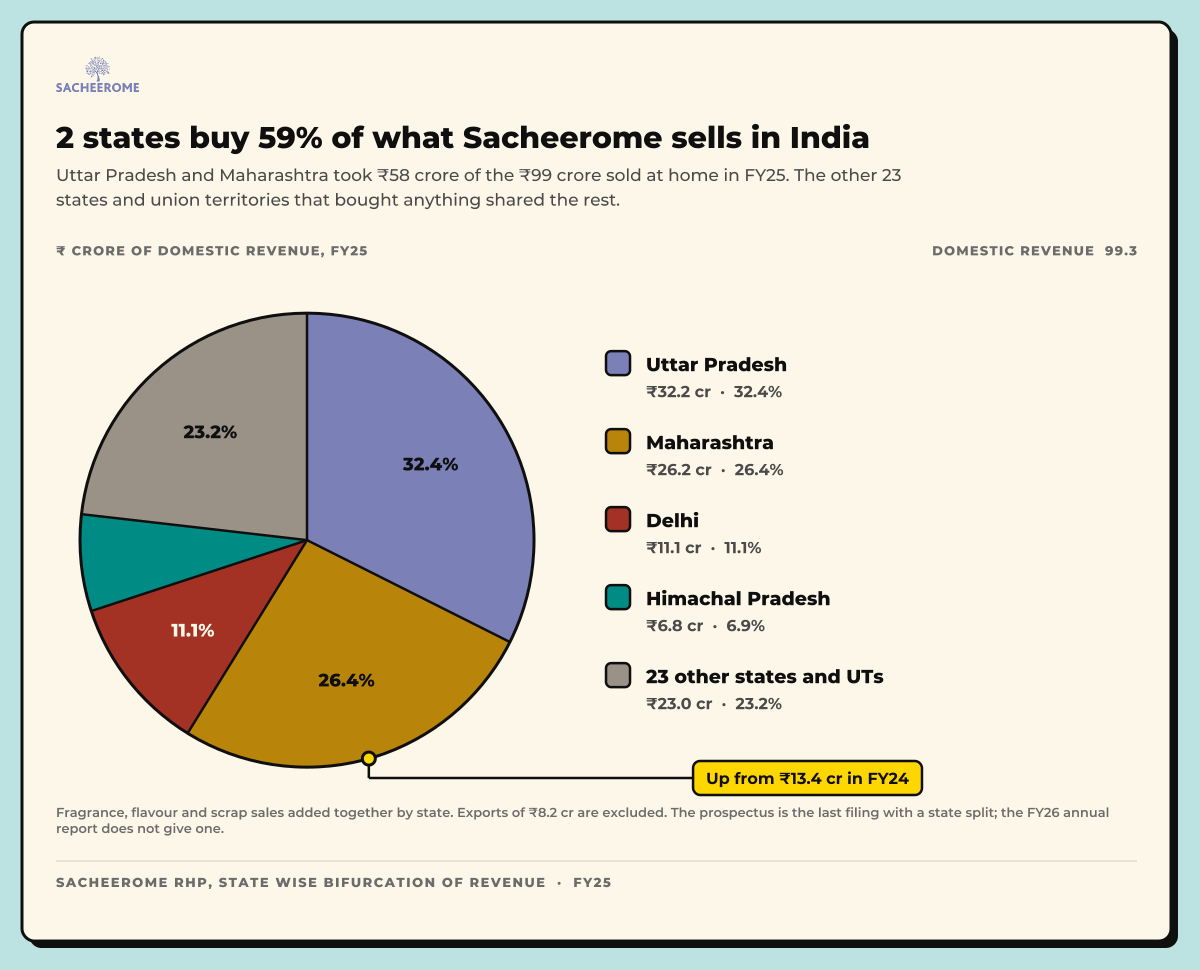
Up from ₹13.4 cr in FY24
Fragrance, flavour and scrap sales added together by state. Exports of ₹8.2 cr are excluded. The prospectus is the last filing with a state split; the FY26 annual report does not give one.
Sacheerome RHP, state wise bifurcation of revenue · FY25
Assets and staff are all in Delhi and, now, YEIDA in Uttar Pradesh. Currency: exports in dollars, inputs bought in rupees from importers. The cash flow statement shows an unrealised exchange gain of ₹19.4 lakh in FY26; there is no hedge and no sensitivity table, the exposure being small.
Cost structure
Of every ₹100 of FY26 sales, ₹60 bought materials, ₹8.4 paid staff, ₹7.5 went on other expenses, ₹1.6 on depreciation and ₹0.1 on interest, leaving ₹22.4 of operating profit before other income. Other income added ₹2.6, mostly deposit interest.
₹60 of every ₹100 buys raw material. ₹19 is profit.
Every line is a share of FY26 revenue from operations. Gross margin has sat near 40% for 4 years; what widened the profit line is the ₹16 of overheads, which was ₹27 in FY23.

Sacheerome FY26 audited results and annual report · FY26
Fixed against variable: materials move with volume; staff and other expenses barely moved as sales grew. Employee cost and other expenses together were ₹19.0 crore in FY23 and ₹24.3 crore in FY26, while revenue went from ₹70.5 crore to ₹152.4 crore: as a share of sales, 27.0% fell to 15.9%. In FY26 alone revenue rose 42% while other expenses rose 4% and employee cost 25%. That is operating leverage, and it runs both ways: a new plant adds fixed cost first.
Contract labour: 23 contractual staff against 158 on the rolls at the IPO. Interest took 0.3% of pre-tax profit and tax 25.3%.
Pricing power
Some, and of a particular kind. Gross margin has stayed within 2 points of 40% for 4 years, 41.1% in FY23 and 40.0% in FY26, through a period in which revenue per kilo rose from about ₹1,230 to about ₹1,450. Input costs rose with it and the company passed them on. Arora's account is that prices were not raised; customers asked for better, dearer products.
Who sets the price: the brand negotiates per formula; Sacheerome's lever is the formula itself, which the brand cannot buy elsewhere. Price caps: none. Discounting in the last downturn: FY26's second half, when the plant was full, shows margin slipping, not price; there is no record of a price cut. Asked on the November call whether raw material increases pass to customers by contract, and with what lag, Arora gave no terms: "What in life does not have the fluctuation?"
Seasonality and cyclicality
Sacheerome reports half-yearly. The second half of FY25 was 13% bigger than the first; the second half of FY26 was 1% smaller, because the plant was full. There is no seasonal pattern the filings disclose; soap and detergent are bought all year, and incense peaks around the festivals.
The cycle it rides is consumer staples, which is mild. The last downturn on record: the flavours line, down 20% in FY25, recovered the next year. The company has not been through a bad year as a listed company, and its 4 public years are all growth.
Growth drivers
- Capacity. The only one that matters now. The old plant is past its rated output; the new one adds 20 lakh kg. Management guided to ₹200 crore of revenue in FY27, ₹250 crore in FY28 and ₹300 crore in FY29, growth of 31%, 25% and 20%, and said FY27 assumed ₹40 to 50 crore from the new plant.
- Existing customers buying more. ₹31.2 crore of FY26's ₹44.9 crore of growth.
- New customers. ₹13.6 crore in FY26.
- Exports. Named in every update as a push; 6.2% of revenue so far.
- Premium products and flavours. A tower of the new plant for flavours; "premium" in the growth strategy.
What is contracted: nothing, by the company's own account of its order pattern. What has to go right: the new plant must clear its licences and run, the top customers must keep growing, and the fixed cost of a ₹184 crore building must be absorbed. The first half of FY27, at 10.34% growth, shows what the business does without the new plant.
Competitive advantage
What stops a rival: the formulas, the relationships and the perfumer. A brand's fragrance is a trade secret held by its fragrance house; a rival must create something the brand likes better than a smell its customers already know. Arora has 40 years of them.
The evidence it exists: a gross margin steady near 40% through 4 years of rising input costs; the claim of no business lost; ₹31.2 crore of growth from existing customers in 1 year; a return on equity of 27% with idle cash on the books.
The limits. The advantage is personal, held by a 67-year-old perfumer and his son. It does not stop the largest customers from leaving; it makes leaving inconvenient. And it is not scale: Givaudan sells CHF 7.5 billion a year and S H Kelkar ₹662 crore in a quarter. How it erodes: if a top customer consolidates its suppliers to a global house, if the new plant's costs force cheaper products, or if the succession from father to son does not carry the formulas with it.
Industry size and growth
The prospectus's industry chapter is a collection of public reports, not a commissioned study, and says so. What it gives:
- The world. The global flavours and fragrances market was USD 32.2 billion in 2023 and is expected to reach USD 43.6 billion by 2032, growing 3.3% a year, by IMARC.
- Indian fragrances. Expected to grow 14.5% a year from 2024 to 2032; the prospectus gives no base figure.
- Indian flavours. ₹4,287 crore in 2023, growing 7.1% a year to ₹8,100 crore by 2032, by IMARC.
Opening the rest…
Free account
Sign up for free to keep reading
A 6-digit code by email, no password. You also get the newsletter.
Already signed up? Use the same email to sign in.
Step 2 of 2
Check your email
Enter the 6-digit code sent to .
·