to enforce a contract in India's courts, nearly 4 years
The curious case of funding "cases"
Five Rivers, a Mumbai AIF, is reportedly raising a $25-50 million fund to finance commercial lawsuits and arbitrations. In return, it gets a share of the money if the case wins. It is the first SEBI-registered fund set up specifically for this. LegalPay has also said it will put ₹100 crore into 20-30 cases, investing ₹2-5 crore per case.
The returns sound too good to be true at 200-300% over 4-5 years, with a 50-70% IRR on winning cases and 30%+ across the portfolio. The funder does not finance every lawsuit. It picks cases where it thinks the claimant has a strong chance of winning.
If a company has a good case but does not have the money or patience to fight it, the funder pays the legal bills and gets a share of the payout if the company wins.
India's courts are slow and expensive. Getting a contract enforced can take about 1,445 days, or nearly 4 years, and cost around 31% of the claim. There are also 1.12 crore civil cases waiting in district courts.
The law is becoming more friendly to litigation funding as well. In 2018, the Supreme Court said non-lawyers could fund lawsuits. In 2023, the Delhi High Court ruled that a funder who was not directly involved in the case did not have to pay the other side's legal costs if the case was lost. But India still has no specific law or disclosure rules for litigation funding.
Burford, the world's largest listed litigation funder, has made $3.9 billion since 2009, generating an 82% return on invested capital, but only a 25% IRR.
8 years from a court's nod to the first fund
The steps from a 2018 Supreme Court line to Five Rivers raising money in 2026. The law settled who can fund a case and who pays when it loses before any dedicated capital showed up.

Court judgments; company statements · Mar 2018 to May 2026
Enforcing a contract in India takes 1,445 days
Days to win a payment through the courts, from the World Bank's last Doing Business report in 2020. India takes almost 4 years, 2.5 times as long as rich countries.
DAYS FROM FILING TO PAYMENT
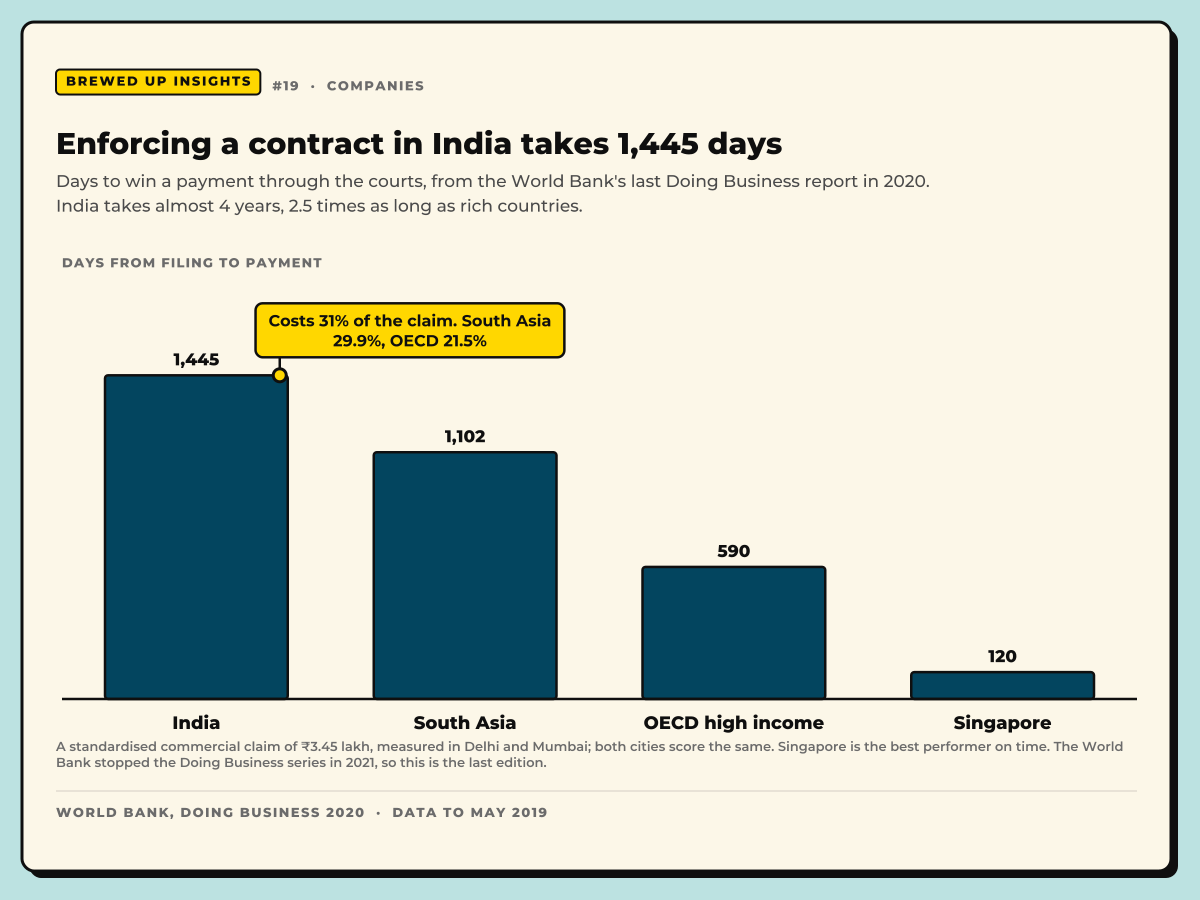
Costs 31% of the claim. South Asia 29.9%, OECD 21.5%
A standardised commercial claim of ₹3.45 lakh, measured in Delhi and Mumbai; both cities score the same. Singapore is the best performer on time. The World Bank stopped the Doing Business series in 2021, so this is the last edition.
World Bank, Doing Business 2020 · Data to May 2019
Sources
- NewsBytes, summarising Mint: Lawsuit as an asset class? Indian investors now think so, 12 May 2026 (Five Rivers $25-50mn, returns, ₹1 crore minimum)
- Mint, Now Indians can bet on the outcome of court cases as litigation funding shapes up to be a new investment asset, 12 May 2026 (reprint)
- 5 Rivers Capital, about the fund: 5 Rivers Capital Fund I, SEBI Category II AIF IN/AIF2/24-25/1652
- SMEStreet, LegalPay to deploy ₹100 crore to back high-merit litigation across India, 19 January 2026
- World Bank, Doing Business 2020: India economy profile, Enforcing Contracts (1,445 days, 31.0% of claim; OECD high income 589.6 days, 21.5%)
- National Judicial Data Grid, district and taluka courts: pending cases, civil and criminal
- Supreme Court, Bar Council of India v A.K. Balaji, 13 March 2018, paragraph 35
- Delhi High Court, Tomorrow Sales Agency v SBS Holdings, 29 May 2023 (₹250 crore claim, SIAC costs orders, funder not liable)
- Burford Capital, Second Quarter 2026 investor presentation, 6 August 2026 ($3.9bn of realisations since 2009, 82% ROIC, 25% IRR)
- Hong Kong Department of Justice, third-party funding provisions in force 1 February 2019
- Chambers, Litigation Funding 2026: Singapore trends and developments (Civil Law (Amendment) Act 2017)