small businesses the yearly ASUSE survey visits, after a bigger sample
The cash economy is now measured by a survey each year
India's new GDP series, which uses 2022-23 as its base year, changes the way the cash-heavy part of the economy is measured.
Earlier, the figure for small household businesses was mostly rolled forward from an old survey, using growth rates or stand-in numbers from elsewhere in the economy, at times from listed companies. Now MoSPI builds a fresh figure every year from 2 surveys it already runs, ASUSE and the Periodic Labour Force Survey (PLFS).
But direct does not mean exact. As Swaminathan Anklesaria Aiyar wrote in the Economic Times on 22 September, ASUSE is still a survey.
ASUSE does not visit every tea stall, repair shop or small business. It visits a sample and scales that sample up to the whole sector. In 2025 it visited 6,70,289 businesses to stand for 7.92 crore. That is about 1 in every 118.
The method is simple enough. There is no full list of these businesses to pick a sample from, so investigators first go to 24,153 chosen villages and city blocks and write down every business they find. They then pick a sample from that list and mostly ask owners what the past month looked like. Only a few larger businesses hand over audited accounts.
The survey covers businesses that are not registered as companies, in manufacturing, trade and other services. It leaves out farming and construction, and it includes proprietorships, partnerships, co-operatives, trusts and self-help groups.
For 2025, ASUSE put the sector at 7.92 crore businesses, 12.81 crore workers and ₹19.93 lakh crore of value added, which is sales minus the cost of goods and services bought in. That is about 6.4% of everything the country produced that year. The sample was also raised about 1.5 times, taking coverage from 1 in 147 businesses to 1 in 118 and making quarterly figures possible.
So the cash economy is still not counted business by business. It is estimated each year from a fresh sample of the sector itself, instead of an old number being moved along by a growth rate borrowed from somewhere else.
That is not the sturdiest way to measure it, but it is a real improvement.
MoSPI's yearly survey visits 1 firm in 118 and estimates the rest
Investigators walked into 6,70,289 firms in the 2025 round. Every figure the survey publishes for all 7.92 crore firms is scaled up from those visits.
FIRMS
- Visited in person0.85%
- Estimated from those visits99.2%
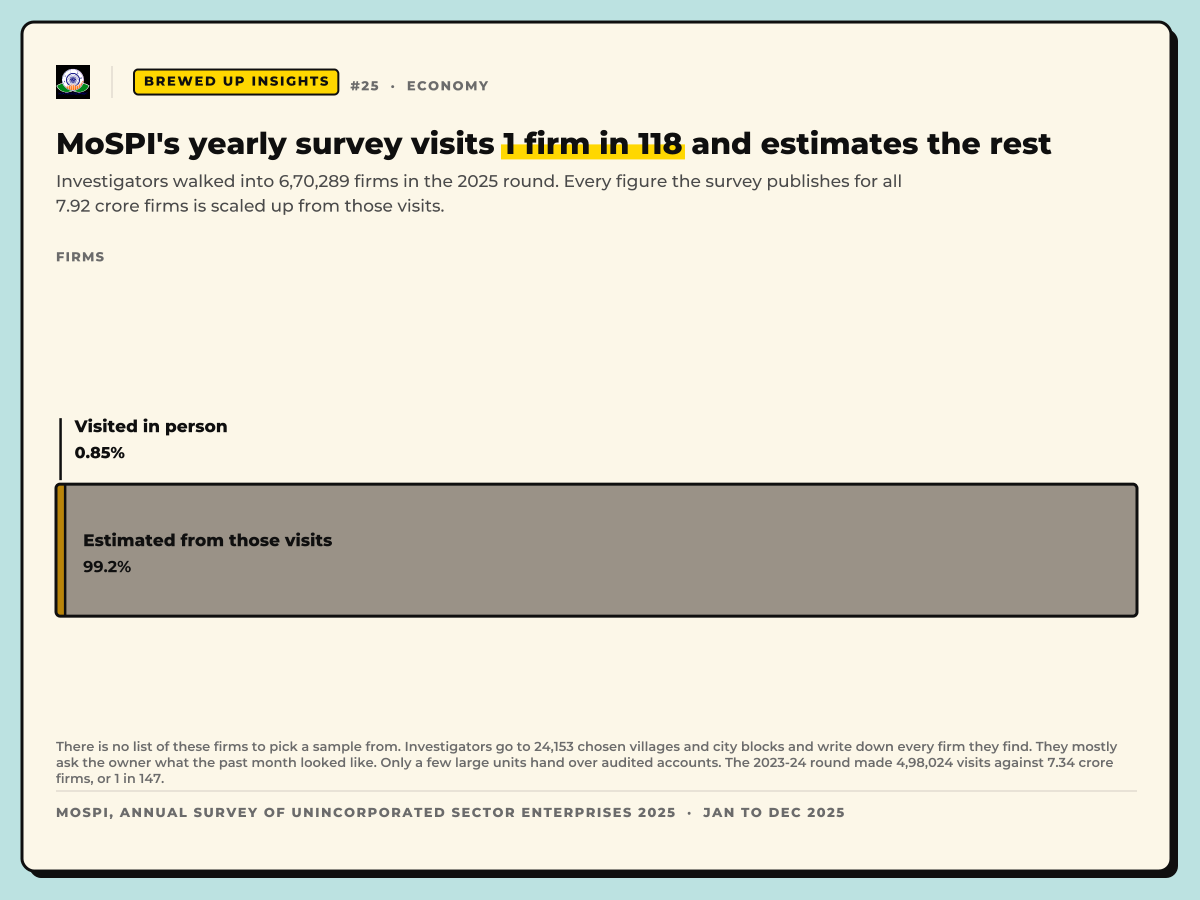
There is no list of these firms, so investigators visit chosen villages and city blocks and count every firm they find.
MoSPI, Annual Survey of Unincorporated Sector Enterprises 2025 · Jan to Dec 2025
Small unregistered firms grew in every survey round
What small unregistered firms add to the economy, across the last 3 rounds of the Annual Survey of Unincorporated Sector Enterprises (ASUSE). Trade and other services drive almost all of it.

₹ LAKH CRORE
Other servicesTradeManufacturing
The survey covers unregistered firms in manufacturing, trade and other services, at current prices. The last step covers 15 months.
MoSPI, Annual Survey of Unincorporated Sector Enterprises · Oct 2022 to Dec 2025
Sources
- PIB, Ministry of Statistics and Programme Implementation, 27 February 2026: new series of GDP estimates with base year 2022-23. Nominal GDP ₹345.47 lakh crore and nominal GVA ₹313.61 lakh crore for 2025-26; the industry table says direct estimates from ASUSE and PLFS replace indicator-based estimates for the quasi-corporate and household sector, and for real estate and professional services replace 'indicator growth derived from Corporate sector'
- MoSPI, Understanding the New Series of GDP, FAQ, 26 February 2026: 'Earlier, the household sector was estimated using growth rates between surveys or proxy indicators. In the new series, actual level estimates are being prepared using regular annual surveys such as ASUSE and PLFS'
- Swaminathan S Anklesaria Aiyar, Economic Times, 22 September 2026: 'Estimating is not fudging'. Notes the oxymoron in 'direct estimates', that ASUSE surveys a sample and grosses it up, and that officials put 45 to 50% of annual GVA on hard administrative data, 30 to 35% on current surveys or measured output, and 15 to 25% on imputations and indirect methods
- PIB, MoSPI, 24 March 2026: ASUSE 2025 results, Table 1. Establishments 6,50,484 to 7,33,995 to 7,92,465 (in '00), workers 10,96,260 to 12,05,998 to 12,80,518 (in '00), GVA ₹15,42,409 crore to ₹17,97,278 crore to ₹19,92,577 crore, GVA per worker ₹1,41,769 to ₹1,49,742 to ₹1,56,539
- MoSPI, press note on ASUSE 2025 (January to December 2025): GVA up 10.87%, trade 16.77%, manufacturing 8.52%, other services 7.36%; GVA shares 42% other services, 37% trade, 21% manufacturing; 6,70,289 establishments surveyed, sample raised about 1.5 times for quarterly selection
- MoSPI, Factsheet of ASUSE 2023-24, Table 2: GVA by broad activity category, manufacturing ₹3,60,724 crore and ₹3,80,341 crore, trade ₹5,53,745 crore and ₹6,24,405 crore, other services ₹6,27,929 crore and ₹7,92,288 crore for 2022-23 and 2023-24
- MoSPI, press note on ASUSE 2023-24 (October 2023 to September 2024): establishments up 12.84%, workers up 10.01%, GVA up 16.52%
- PIB, MoSPI, 27 March 2026: Periodic Labour Force Survey Annual Report 2025. Self-employed 58.2% of workers in 2023, 57.5% in 2024, 56.2% in 2025; worker population ratio 57.4% and labour force participation 59.3% for persons aged 15 and above