Growth in pay to banks and other sellers, FY23 to FY25; premium grew 28%
Key takeaways from the IRDAI paper that sank insurance stocks
1. IRDAI limits how much insurers can spend on selling and running their business. From FY28, the limit will fall every year for 5 years. Crop insurance will count as only 1/3rd of the premium while calculating the limit, while spending on technology, insurance awareness and rural and government schemes will now count within the same overall limit.
2. Life insurance sellers will be paid for keeping customers, not just signing them up. On a policy you pay into for 10 years or more, a bank or broker can get at most 20% of your first year's payment, and an agent 25%. Shorter plans pay much less. One-time payment savings plans pay just 1% to 2%. From year 6, what the seller earns each year slowly rises, up to 7%.
3. Banks and NBFCs, lenders that are not banks, can no longer force you to buy insurance to get a loan. They can still offer a deal, like a lower interest rate if you insure the loan. But they must show you both rates, let you buy the cover from anyone, and have you pay for it separately. On insurance sold with a loan, their pay is capped at 2% to 2.5% for life cover and 5% for health.
4. Selling health and vehicle insurance will pay much less. On your first health policy, a bank or broker can get at most 15% of what you pay, and an agent 20%. When you renew or switch, that drops to 5% and 10%. Brokers were earning about 30% on health policies in FY25. On a new vehicle, the seller gets nothing for the compulsory third-party cover.
5. Agents who work for one insurer can earn more than distributors who sell for many. IRDAI says selling for many makes it too easy to push whichever insurer pays the most. This favours insurers with big agent networks, like LIC.
6. Banks and brokers can sell for as many insurers as they like. Today a bank can sell for at most 9 insurers in each type of insurance. The 8 kinds of distributors become 3, and starting one needs just ₹10 lakh. This loosens the hold bank-owned insurers have on their parent bank's customers.
7. The biggest insurers are already cheap to run. The 2 largest life insurers spend ₹10 to ₹12 of every ₹100 they collect on costs, while the rest spend ₹22. In general insurance, the largest insurer spends ₹18 and the rest ₹29. Insurers already close to the new limits have the least to change. As a small offset for the rest, IRDAI cuts its own fee on insurers from 0.05% to 0.04% of premium.
8. NBFCs have leaned hard on insurance sold with loans. Their life insurance sales have nearly tripled since FY23, and they keep about ₹42 of every ₹100 of new premium. About 93% of it is one-time cover that pays off the loan if the borrower dies. Point 3 cuts their pay on this to 2% to 2.5%. Across banks and other corporate agents, sellers' pay grew 125% from FY23 to FY25, while the premium they brought in grew just 28%.
9. Buying directly gets easier. Your payment must go straight from your own account, UPI or card to the insurer, never through the seller. The insurer must check with you directly, by OTP, before issuing the policy. Vehicle dealers must tell buyers they can buy cover on Bima Sugam, the insurers' own online store.
10. The last rules failed because they were easy to get around. After 2023, each insurer's board set its own commission policy, and the paper says board approval "has often been a formality". This time, trips, gifts, awards and expense claims all count as commission. Insurers that overspend can be stopped from launching products, paying dividends, or selling through the channel that overspent. Every insurer, and every distributor earning over ₹100 crore in commission, needs a yearly cost audit.
None of this is final yet. These are proposals, open for comments until 25 October 2026 at http://iib.gov.in/dr.
Less of every ₹100 you pay as premium will go on costs now
Out of every ₹100 of life insurance premium, how much goes on sellers’ commission and running costs. General insurance must fall from ₹32.1 to ₹20 by FY32.

PRIVATE LIFE INSURERS, ₹ OUT OF EVERY ₹100 OF PREMIUM
Commission and running costsLeft for claims and savings
IRDAI consultation paper, Boxes 1 and 2 · FY26 to FY32
Currently, up to ₹81 of your first-year life premium goes to the seller
Out of every ₹100 you pay in a life policy’s first year. Red is the average seller’s cut; the black mark is the most any insurer paid.

IRDAI consultation paper, Graph 7 · Year not stated
Private insurers pay sellers nearly double what state ones do
Out of every ₹100 of premium in FY26, how much went to sellers as commission. Among private insurers it ranged from ₹3 to ₹39 in life and ₹15 to ₹31 in general.
₹ TO SELLERS, OUT OF EVERY ₹100 OF PREMIUM
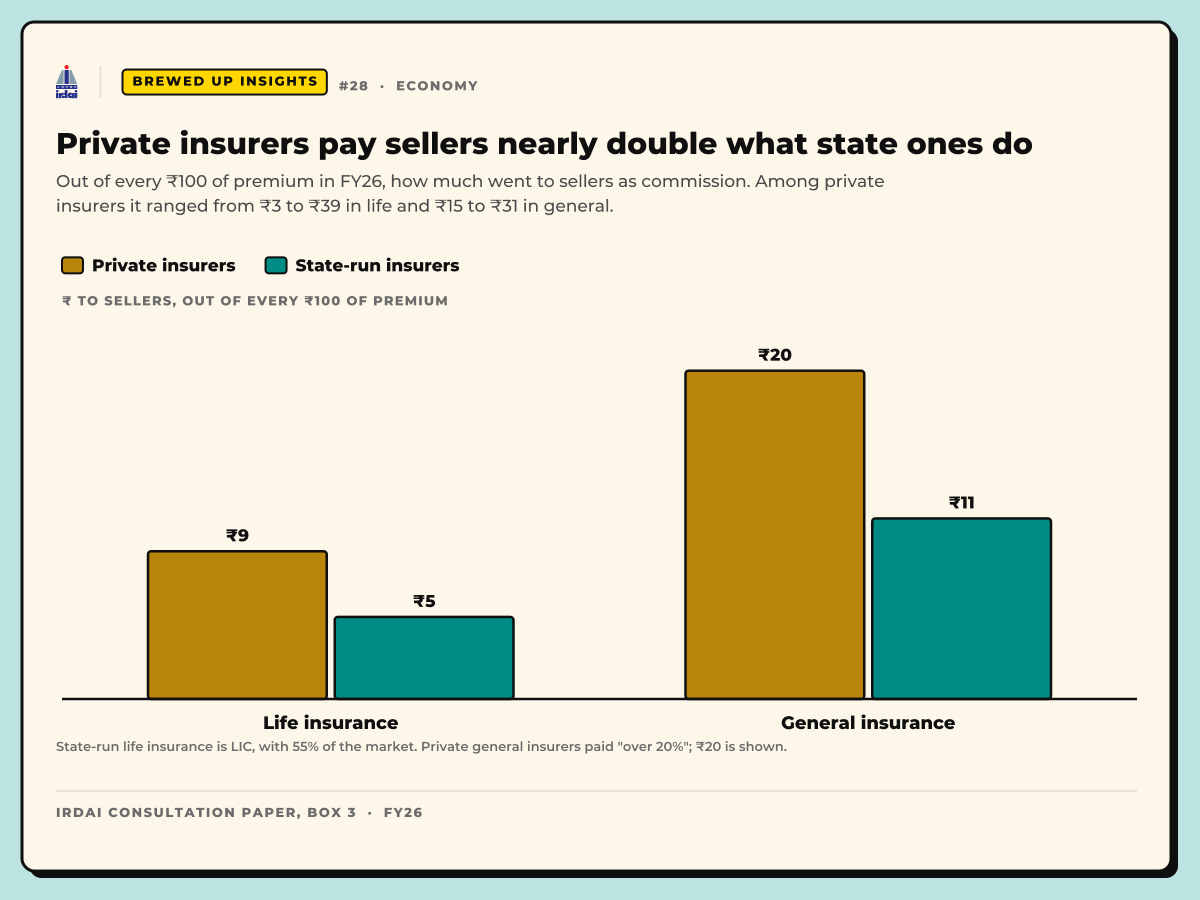
State-run life insurance is LIC, with 55% of the market. Private general insurers paid "over 20%"; ₹20 is shown.
IRDAI consultation paper, Box 3 · FY26
Premiums grew nearly 3x, but life policies stayed flat
Each line starts at 100 in FY15 and shows where it was in FY25. Premiums kept pace with GDP, but the number of life policies did not grow.

IRDAI consultation paper, Graphs 1 and 3 · FY15 to FY25
Sources
- IRDAI, Recalibrating Economics of Insurance Distribution, Part 1: Distribution Reforms, public consultation paper, September 2026 (80 pages), on the consultation portal the paper names, comments until 25 October 2026. Every figure in points 1 to 10 is from this paper
- NSE quote page for POLICYBZR, PB Fintech, down 36.0% (₹1,886.30 to ₹1,207.20): closes of 23 and 24 September 2026 behind the move quoted
- NSE quote page for MFSL, Max Financial Services, down 9.8% (₹1,562.90 to ₹1,410): closes of 23 and 24 September 2026 behind the move quoted
- NSE quote page for HDFCLIFE, HDFC Life, down 6.2% (₹561.50 to ₹526.90): closes of 23 and 24 September 2026 behind the move quoted
- NSE quote page for LICI, LIC, down 0.4% (₹407.50 to ₹406): closes of 23 and 24 September 2026 behind the move quoted
- NSE quote page for SBILIFE, SBI Life, down 0.3% (₹1,760 to ₹1,755): closes of 23 and 24 September 2026 behind the move quoted