of Indian workers who travel to work go by two-wheeler
Two-wheelers carry 42.6% of Indian workers, while buses and trains just 9%
India's statistics office (NSO, part of MoSPI) released its first-ever National Household Travel Survey on 5 October 2026. It surveyed 4,92,023 households, covering over 20 lakh people, on how they travelled between July 2025 and June 2026. Only trips longer than 1 km count.
Two-wheelers are the most common way to get to work. 42.6% of workers who travel to work use them. In cities, the share rises to 52.3%, while in villages it is 37.1%.
Buses and trains play a much smaller role. Buses carry 6.7% of workers, metro and suburban trains 2.1%, and other trains 0.2%. Together, that is 9%. Walking accounts for another 28.3% of workers, cycling 10.7%, and cars 3%.
Metros and suburban trains are important in a few places, though. They carry 5% of city workers across India, but the share rises to 20.7% in Maharashtra, 16.5% in West Bengal and 14.4% in Delhi. Students have different travel habits: 37% walk to their place of study and 29.5% take a bus. Only 6.7% use two-wheelers.
Most workers do not take long or spend much getting to work. 83.4% reach work in under 30 minutes. The average monthly cost is ₹785, but it is higher in cities at ₹1,044 than in villages at ₹612.
There is also a gap between men and women. 61.9% of male workers travel more than 1 km to work daily, compared with 41.9% of female workers. Women also spend less on their commute, averaging ₹533 a month against ₹835 for men.
The survey was partly designed to meet the Ministry of Railways' data needs. But railways matter more for overnight trips than daily commutes. Of all household overnight trips, inter-city trains carry 17.7%, while buses lead at 55.8%.
This is India's first nationwide household travel survey, so there is no earlier survey to compare it with. But the picture is clear, daily travel depends heavily on two-wheelers and walking. Buses and trains together carry fewer than 1 in 10 workers, while metro and suburban trains have a significant share mainly in a few states.
Two-wheelers carry 42.6% of workers, buses and trains 9%
How Indian workers who travel more than 1 km get to work, July 2025 to June 2026. In cities, 52.3% ride a two-wheeler and 14.5% take a bus or train.

% OF WORKERS WHO TRAVEL TO WORK
VillagesCities
Bus or train adds buses, metro and suburban trains, and other trains. Workers aged 15 and above; trips under 1 km were not counted.
MoSPI (NSO), National Household Travel Survey, press note of 5 October 2026 · Jul 2025 to Jun 2026
Metro and suburban trains carry 5% of India's city workers
City workers who commute by metro, monorail, suburban rail or tram, July 2025 to June 2026. In Maharashtra the share is 4 times India's.

% OF CITY WORKERS WHO TRAVEL TO WORK
The press note names only these 3 states. Workers aged 15 and above who travel more than 1 km to work.
MoSPI (NSO), National Household Travel Survey, press note of 5 October 2026 · Jul 2025 to Jun 2026
Fewer women workers than men make a daily work trip
Workers aged 15 and above who make a daily trip of more than 1 km to work, July 2025 to June 2026. The gap is widest in villages: 59.6% of men, 37.7% of women.

% OF WORKERS WHO MAKE A DAILY WORK TRIP
MenWomen
Trips of more than 1 km only. Women workers who do travel also spend less on it: ₹533 a month against ₹835 for men.
MoSPI (NSO), National Household Travel Survey, press note of 5 October 2026 · Jul 2025 to Jun 2026
Buses carry 55.8% of household overnight trips, trains 17.7%
How households travel on trips that keep them away for more than a day, July 2025 to June 2026. Buses carry 3 times as many of these trips as trains.
% OF HOUSEHOLD OVERNIGHT TRIPS
- Bus55.8%
- Inter-city train17.7%
- Car15.1%
- Two-wheeler8.8%
- Other2.6%
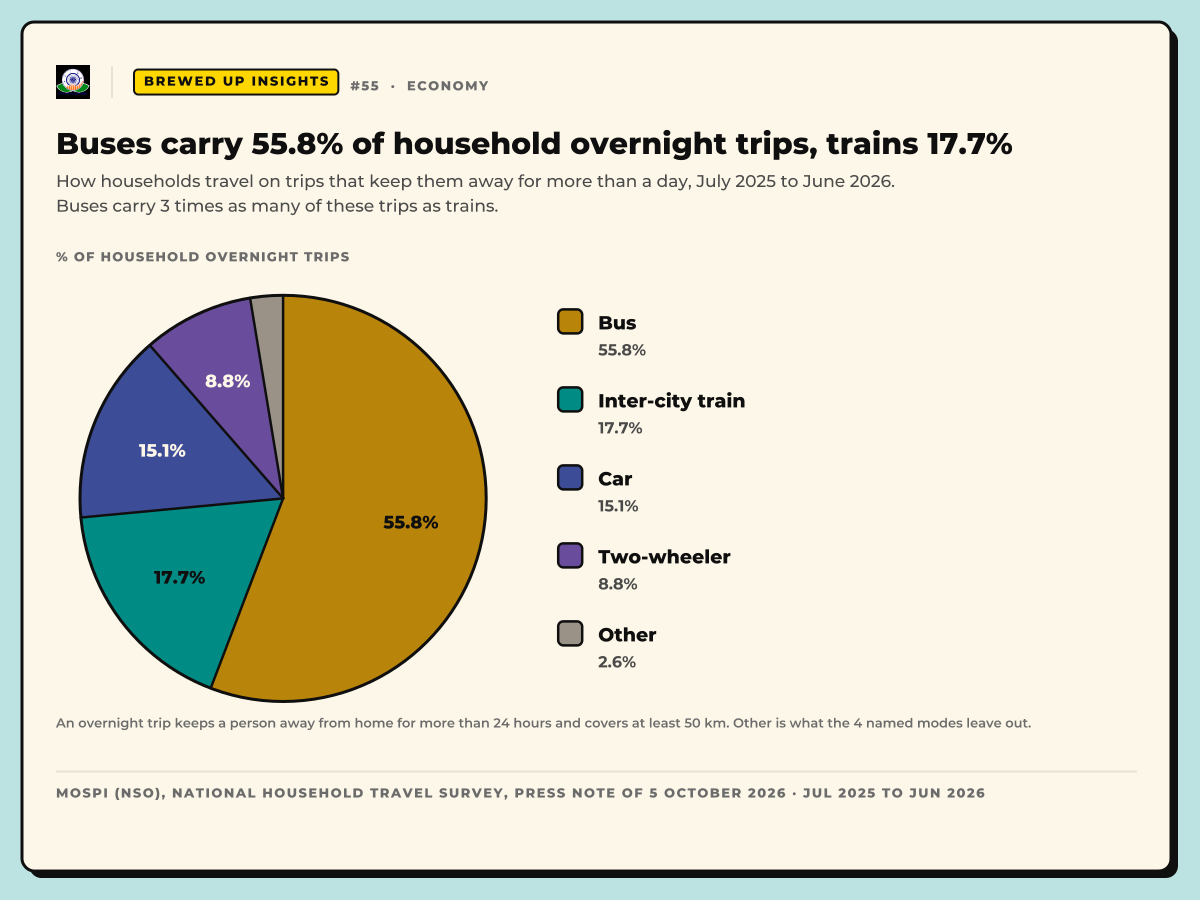
An overnight trip keeps a person away from home for more than 24 hours and covers at least 50 km. Other is what the 4 named modes leave out.
MoSPI (NSO), National Household Travel Survey, press note of 5 October 2026 · Jul 2025 to Jun 2026