1 of 5
RBI rupee steps is good news for Monday: dollars for the oil firms
A primer on the recent RBI developments
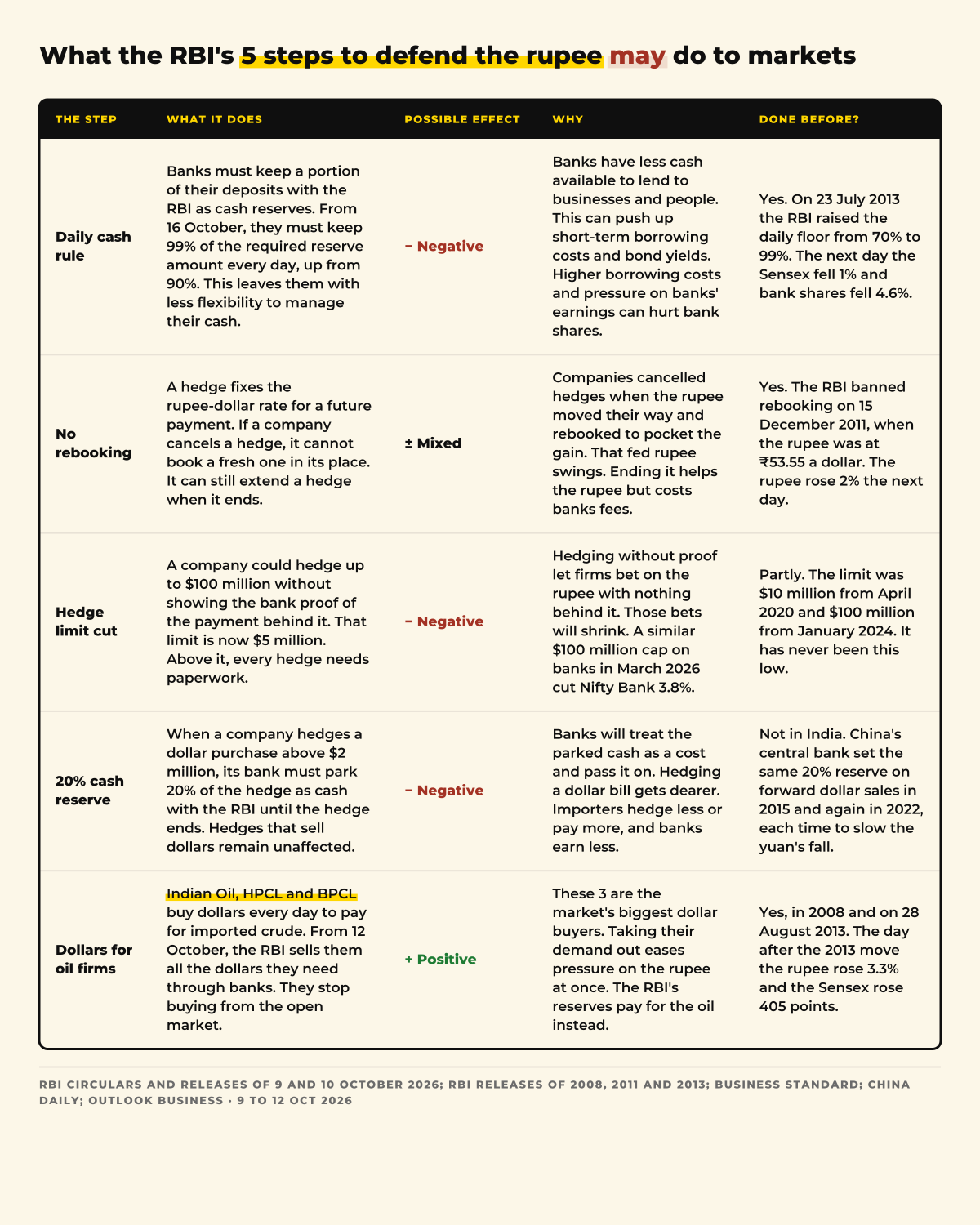
The RBI's 5 steps to defend the rupee, taken between 9 and 12 October 2026, and how each could play out:
What the RBI's 5 steps to defend the rupee may do to markets
| The step | What it does | Possible effect | Why | Done before? |
|---|---|---|---|---|
| Daily cash rule | Banks must keep a portion of their deposits with the RBI as cash reserves. From 16 October, they must keep 99% of the required reserve amount every day, up from 90%. This leaves them with less flexibility to manage their cash. | − Negative | Banks have less cash available to lend to businesses and people. This can push up short-term borrowing costs and bond yields. Higher borrowing costs and pressure on banks' earnings can hurt bank shares. | Yes. On 23 July 2013 the RBI raised the daily floor from 70% to 99%. The next day the Sensex fell 1% and bank shares fell 4.6%. |
| No rebooking | A hedge fixes the rupee-dollar rate for a future payment. If a company cancels a hedge, it cannot book a fresh one in its place. It can still extend a hedge when it ends. | ± Mixed | Companies cancelled hedges when the rupee moved their way and rebooked to pocket the gain. That fed rupee swings. Ending it helps the rupee but costs banks fees. | Yes. The RBI banned rebooking on 15 December 2011, when the rupee was at ₹53.55 a dollar. The rupee rose 2% the next day. |
| Hedge limit cut | A company could hedge up to $100 million without showing the bank proof of the payment behind it. That limit is now $5 million. Above it, every hedge needs paperwork. | − Negative | Hedging without proof let firms bet on the rupee with nothing behind it. Those bets will shrink. A similar $100 million cap on banks in March 2026 cut Nifty Bank 3.8%. | Partly. The limit was $10 million from April 2020 and $100 million from January 2024. It is the lowest since the limit began in 2020. |
| 20% cash reserve | When a company hedges a dollar purchase above $2 million, its bank must park 20% of the hedge as cash with the RBI until the hedge ends. Hedges that sell dollars remain unaffected. From 12 October, the rule also covers banks' own dollar-buying hedges. | − Negative | Banks will treat the parked cash as a cost and pass it on. Hedging a dollar bill gets dearer. Importers hedge less or pay more, and banks earn less. | Not in India. China's central bank brought in the same reserve on forward dollar sales in 2015 and set it at 20% in 2022, each time to slow the yuan's fall. |
| Dollars for oil firms | Indian Oil, HPCL and BPCL buy dollars every day to pay for imported crude. From 12 October, the RBI sells them all the dollars they need through banks. They stop buying from the open market. | + Positive | These 3 are among the market's biggest dollar buyers. Taking their demand out eases pressure on the rupee at once. The RBI's reserves pay for the oil instead. | Yes, in 2008 and on 28 August 2013. The day after the 2013 move the rupee rose 3.3% and the Sensex rose 405 points. |
RBI circulars and releases of 9 and 10 October 2026; RBI releases of 2008, 2011 and 2013; Business Standard; China Daily; Outlook Business · 9 to 12 Oct 2026
Sources
- RBI, circular DoR.RET.REC.247/12.01.001/2026-27, Change in Daily Minimum Cash Reserve Maintenance Requirement (9 October 2026)
- RBI, A.P. (DIR Series) Circular No. 25, Risk Management and Inter-Bank Dealings: rebooking, the $5 million threshold (10 October 2026)
- RBI, A.P. (DIR Series) Circular No. 26, Risk Management and Inter-Bank Dealings: Foreign Exchange Risk Reserve (10 October 2026)
- RBI, press release 2026-2027/1305, RBI Announces Regulatory Measures for the Foreign Exchange Market (10 October 2026)
- RBI, press release 2026-2027/1306, special window for public sector oil marketing companies to meet dollar requirements (10 October 2026)
- RBI, press release 2013-2014/154, RBI announces additional measures to address exchange market volatility (23 July 2013): the daily CRR floor from 70 to 99 per cent
- Business Standard (PTI), Sensex snaps 5-day rally, down 211 pts as RBI steps hurt banks (24 July 2013)
- RBI, press release of 15 December 2011, Risk Management and Inter Bank Dealings: forward contracts once cancelled cannot be rebooked
- US Federal Reserve, H.10 foreign exchange rates, historical rates for the Indian rupee (noon buying rates in New York)
- RBI, A.P. (DIR Series) Circular No. 29, Risk Management and Inter-Bank Dealings: Hedging of foreign exchange risk (7 April 2020), the USD 10 million facility
- RBI, A.P. (DIR Series) Circular No. 13, Risk Management and Inter-Bank Dealings: Hedging of foreign exchange risk (5 January 2024), the USD 100 million facility
- Outlook Business, Nifty Bank plunges over 3% after RBI's $100 million forex cap (30 March 2026)
- China Daily, Forex risk reserve ratio up to 20% (27 September 2022): the PBOC's reserve on forward dollar sales, introduced in August 2015
- RBI, press release 2007-2008/1534, Special Market Operations (30 May 2008): foreign exchange for the oil companies through designated banks
- RBI, press release 2013-2014/437, RBI introduces Forex Swap Window for Public Sector Oil Marketing Companies (28 August 2013)
- Business Standard (PTI), RBI rescue effort lifts rupee by most in 15 years, stocks jump (29 August 2013)
- CNBC (Reuters), India unveils tough curbs on dollar demand to defend rupee (10 October 2026)
- RBI, Bulletin Weekly Statistical Supplement, Extract, October 9, 2026 (press release 2026-2027/1299)
- RBI, Bulletin Weekly Statistical Supplement, Extract, September 11, 2026 (the September 4 peak)