of Yes Bank AT-1 bonds, written to zero in 2020, revived
Yes Bank's ₹8,415 crore AT-1 bonds return after Supreme Court ruling
On 15 October 2026, the Supreme Court restored ₹8,415 crore of Yes Bank's AT-1 bonds, which had been written off during the bank's rescue in March 2020. AT-1 bonds are a type of bank debt that can be written off when a bank gets into trouble.
The ruling came down to 1 detail. The RBI's draft rescue plan said the bonds would be permanently written off, but the final plan removed that line. The court ruled that the RBI's administrator had no authority to write them off without it.
The decision brings ₹8,415 crore of debt back onto Yes Bank's books. The bank says its core equity ratio will fall from 14.0% to about 11.5%, leaving it with a smaller cushion to absorb losses. Bondholders regain their claim on the bank, with interest rates of 9.5% on ₹3,000 crore issued in 2016 and 9.0% on ₹5,415 crore issued in 2017. Together, these amount to about ₹772 crore in annual interest. Whether bondholders are owed interest missed since 2020 remains undecided.
The court also noted that Yes Bank had sold these bonds to ordinary investors against RBI rules. The takeaway: bondholders who were told their money was gone in 2020 have their claim back, while Yes Bank faces a potential annual interest bill of ₹772 crore and a thinner cushion to absorb losses.
How Yes Bank's AT-1 bonds went to zero and came back
The draft rescue plan wrote the bonds off. The final plan did not, and the administrator did it anyway.

Supreme Court judgment of 15 October 2026; Gazette of India; RBI; Yes Bank BSE filings · 2016 to 2026
Yes Bank's equity layer falls 2.5 points, Tier-1 stays at 14%
Yes Bank's Tier-1 capital as a share of risk-weighted assets at 30 June 2026, before and after the ruling. The ₹8,415 crore leaves equity and comes back as AT-1, so the total does not move.

% OF RISK-WEIGHTED ASSETS
CET-1, the equity layerAT-1, the rest of Tier-1
After the ruling: CET-1 is 14.0% less the 2.5 points Yes Bank expects, including profits. AT-1 is the rest of the 14.0% Tier-1 the bank says is unchanged. Pro forma, as stated on 16 October 2026.
Yes Bank, BSE filings of 18 July 2026 (Q1 FY27 results) and 16 October 2026 · 30 Jun 2026, pro forma
Yes Bank's revived bonds carry about ₹772 crore of coupon a year
The annual coupon on the 2 revived series at their issue rates, in ₹ crore. The court says coupons are to be paid as the bond documents provide; the RBI's rules let a bank cancel one.
₹ CRORE A YEAR
- December 2016 series: 9.5% on ₹3,000 crore285 36.9%
- October 2017 series: 9.0% on ₹5,415 crore487 63.1%
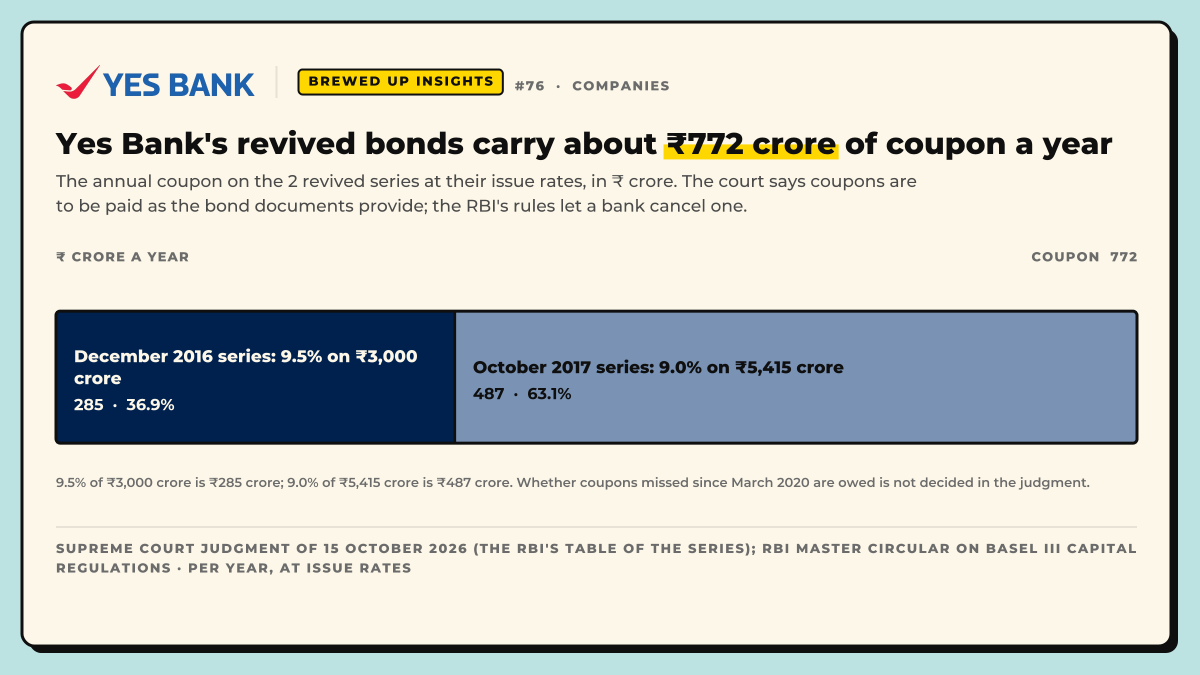
9.5% of ₹3,000 crore is ₹285 crore; 9.0% of ₹5,415 crore is ₹487 crore. Whether coupons missed since March 2020 are owed is not decided in the judgment.
Supreme Court judgment of 15 October 2026 (the RBI's table of the series); RBI Master Circular on Basel III Capital Regulations · Per year, at issue rates
Sources
- Supreme Court of India, Yes Bank Ltd v Axis Trustee Services Ltd, Civil Appeal 3182 of 2025, judgment of 15 October 2026 (2026 INSC 1132), from sci.gov.in (PDF)
- Yes Bank, BSE filing of 16 October 2026: disclosure on the Supreme Court judgment on the AT-1 bonds, with Annexure A (PDF)
- Yes Bank, BSE filing of 15 October 2026: clarification on the CNBC-TV18 news item, with the sequence of events since March 2020 (PDF)
- Yes Bank, BSE filing of 18 July 2026: press release and investor presentation on the Q1 FY27 results (PDF)
- Yes Bank, BSE filing of 6 May 2020: audited results for the quarter and year ended 31 March 2020, with the press release (PDF)
- Ministry of Finance, Yes Bank Limited Reconstruction Scheme, 2020: Gazette of India notification G.S.R. 174(E) of 13 March 2020 (PDF)
- RBI press release 2019-2020/2028 of 6 March 2020, 'Yes Bank Ltd.: RBI announces Scheme of Reconstruction', with the draft Yes Bank Ltd. Reconstruction Scheme, 2020
- RBI, Master Circular on Basel III Capital Regulations, DBR.No.BP.BC.1/21.06.201/2015-16 of 1 July 2015 (PDF)
- Axis Trustee Services, Yes Bank Limited AT1 bond issuances: disclosures as on 27 February 2026 (PDF)
- Nippon India Mutual Fund, Notice cum Addendum No. 78 of 15 October 2026: temporary suspension of subscription in Nippon India Retirement Fund, Wealth Creation and Income Generation schemes (PDF)